Alternative Medicine |
QUALITY ASSURANCE IN MEDICINE: HOW TO CIRCUMVENT
THE RULES
Willem Betz
University of Brussels VUB, Department of Family Medicine
Laarbeeklaan, 103, B-1090 Brussels, Belgium
Email: wbetz@huis.vub.ac.be
Evidence Based Medicine Today
Medicine has entered a phase where it is accepted that all diagnostic and
therapeutic acts should be based on evidence. This rule should be applied to all medical
procedures without exception, whether they are based on the supernatural, folk-lore,
tradition or even logic reasoning. This implies that all medical interventions have to be
put to the test. The accepted procedure to evaluate medical procedures is the randomised
clinical trial with control group, but, one trial is not sufficient. The results must be
reproduced by multiple independent researchers. Another important factor determining the
acceptance of any medical act is safety. Immediate dangers are relatively easy to detect
but the long term side effects can only be detected by objective methods of registration
and diagnosis.
Those rules are the main pillars of today's evidence based medicine (EBM)
and one could hope that in the near future only EBM should be offered to the public and
that all non EBM should be abandoned.
This means that there are only 3 kinds of medicine:
0. EBM = having sufficient proof.
1.a. Today's best choice.
1.b. EB but obsolete: discarded and replaced by better or safer
0. Experimental medicine = in the process of
evaluation, under strict ethical conditions.
0. Quackery: having no convincing or negative
evidence.
In which category a treatment is to be placed depends mainly on
publications in top level journals, which are then often translated into guidelines or
standards for the medical community and often adopted by the health insurance
organisations.
Alternative Medicine
Some groups are striving to recognize a fourth kind of medicine that should
not obey the rules of EBM: They call it Alternative Medicine. (or complementary or CAM,
or…). Not succeeding in convincing the academic world, they try to bypass the tests and
appeal directly to politicians to gain official recognition. Some of the arguments they
use to attain this will be elaborated and discussed in more detail, as well as the
results.
ARGUMENTS TO GAIN RECOGNITION
Popularity (political importance):
The people use it and want it (20% -40%- 60% 80%!).
Satisfied patients are proof enough.
The Great Conspiracy:
We have evidence but the establishment ignores it".
Different Logic:
We can not produce evidence in the orthodox way.
If the scientific method can not prove AltMed, then it is a bad method.
The Underdog:
No commercial incentives/possibilities for testing
We are recognized in other countries, why not here?
Different Criteria:
Only a Homeopath can judge a homeopath
We do not treat Diseases. We treat People
Orthodox statistics are not applicable.
Economical: AltMed is cheap.
Ecological:
Natural is safe and healthy
AltMed is natural, soft, non-toxic.
Anthropological and Sentimental: AltMed is Age Old Traditions.
Medical: AltMed improves the Quality of Life(???).
Altruistic: The people have a right to Good Quality AltMed.
METHODS USED TO OBTAIN RECOGNITION
Twist: Presenting incorrect information to the public and politicians
Manipulate and Control:
Creation of recognition boards composed of only adepts
Create monopolies.
Re-baptise: Treatments become food supplements.
Attack Academic Medicine:
"Cut Burn and poison".
"Only 15% is EBM"
"Millions of people die in hospitals"
Corrupted by the pharma industry.
Since SciMed is so bad, then AltMed must be Good
Appeal to Freedom: Right to Freedom of Choice.
Equal rights: Stop the Discrimination!
A flock of birds:
Dispersing after negative results.
Regrouping when positive study appears.
Plain cheating: Ignore the laws and pay the modest fines.
DISCUSSION OF SOME SUCCESSES OBTAINED
In the EU: The Simplified registration of Homeopatic and Anthroposophic
Medication.
In Germany: Binnenanerkennung, The E-Commission.
In Belgium: Classification of herbal drugs as food supplements.
In The Netherlands: Abolition of doctors' monopoly on diagnosis and
treatment. Recognition by boards of peers. Homeopathic medication registered with
indication but without proof.
In the USA: Escaping control by the FDA. The Acupuncture Board. The DSHEA.
In the WHO: The rule of assumed safety. The indications for acupuncture.
Several Laws have been passed silently.
RECOMMENDATIONS FOR THE FUTURE:
The patient will not be protected by publications in medical journals.
The lawmakers and the courts will decide.
Doctors must assume their responsibilities and we need jurists.
Close surveillance and follow up on planned laws on Medicine and Pharmacy.
Watch over strict application of EU directives.
Do not count on the governments to do this.
Collect advertisements with false health claims and use the laws on false
advertising claims. To file complaints.
Use the laws on commerce and unfair competition and file complaints
Contest recognition as food supplements.
Do not underestimate the power of the AltMed lobbies.
No more subsidies for research unless EU COSTB4 rules applied.
WHY DO BOGUS MEDICAL THERAPIES SEEM TO WORK?
Barry L. Beyerstein
Brain Behavior Laboratory, Department of Psychology, Simon Fraser University
8888 University Drive, Burnaby, British Columbia, Canada
E-mail: bbeyerstein@arts.sfu.ca
Why do many otherwise intelligent and well-educated people believe that
scientifically discredited therapies can cure various diseases? Although most alternative
or “complementary” therapies have been shown to be useless, if not actually dangerous,
there are many subtle psychological and social processes that can convince patients that
they have been helped by dubious treatments such as homeopathy, therapeutic touch, most
herbal remedies, joint manipulation, acupuncture, and the like.
In this paper, the author distinguishes between disease, a bodily
dysfunction caused by infection, trauma, degeneration, carcinogenesis, etc., and illness,
the feelings of malaise, lethargy, pain, hopelessness, etc., that can accompany the course
of a disease. While Complementary and Alternative Medicine (CAM) has shown very little
ability to cure diseases, it can, for psychological reasons, alleviate illness symptoms.
Many patients mistake this subjective improvement for actual amelioration of the
underlying disease. This kind of symptomatic relief can be beneficial nonetheless, as long
as it does not divert patients from proven therapies that would actually cure their
disease (perhaps until it is too late for the proven treatment to work). It does, however,
contribute to a false estimate of the powers of CAM. Since many patients take their
“complementary” nostrums in addition to scientifically proven treatments, the bogus
products may be given credit that ought to go to the biomedical intervention.
This paper explores a number of social and psychological factors that can
lead to erroneous beliefs that CAM cures diseases. Factors such as these can make the
suffering associated with symptoms seem less noxious, even if the underlying disease is
untouched. Because CAM practitioners downplay the need for control groups and randomized
clinical trials, the testimonials from satisfied customers they rely on almost exclusively
count for very little as evidence for such treatments. In addition to placebo effects,
satisfied CAM patients may also have benefited from the normal processes of recovery
(i.e., the disease has run its natural course). Patients often erroneously attribute this
recovery, which would have occurred without any intervention at all, to the worthless
treatment.
Similarly, if the diagnosis (by one’s self or one’s physician) was
incorrect to begin with, patients may credit inert treatments with curing them of diseases
they never really had. If the complaint is actually psychosomatic, the symptoms may well
abate due to the mere comfort and reassurance that belief in the CAM treatment will
provide. There are also various demand characteristics and psychological payoffs in the
therapist-client relationship that can make patients overestimate, and incorrectly recall,
the amount of benefit they actually received.
Alternative medical products are vigorously marketed and overblown claims
are routinely made (and often credulously spread by sympathetic members of the media).
This, plus the upbeat, charismatic personalties and strong salesmanship of alternative
therapists, can lead to exaggerated patient expectations. In anticipation of this promised
improvement, clients’ moods may improve and they may begin to eat, sleep, socialize, and
exercise better. These improvements in lifestyle can have beneficial effects that can be
mistaken for direct results of the alternative therapy.
Many users of alternative medicine are committed to a variety of New Age
beliefs that are associated with the magical, animistic, and vitalistic philosophy that
underlies CAM, and they may be hostile to the social and economic power of the scientific
medical profession as well. These attitudes make it difficult for patients to assess the
treatments they receive objectively. Because their belief in alternative medicine is
typically part of a much broader worldview, attacking one part threatens the philosophical
whole. Thus, believers in CAM will be prone to distort their memory, logic, and
perception, rather than have to admit that a central part of their cosmological belief
system is invalid.
For all these reasons, testimonials from satisfied customers are
insufficient proof of efficacy for any kind of therapy. Thus, it is essential that
putative treatments be subjected to rigorous double-blind, randomized clinical trials
before they can be assumed to be valid.
“ALTERNATIVE“ MEDICINE IN GERMANY
FACTS, TRENDS, AND STATUTORY HEALTH INSURANCE SYSTEM
Barbara B. Burkhard, MD
Medizinischer Dienst der Krankenversicherung in Bayern
D – 81739 Munich, Germany
E-mail: barbara.burkhard@mdk-in-bayern.de
So called “alternative” or “complementary” medicine - combined as
CAM - is a profitable market, almost without legal restriction. The providers are global
players. When we want to figure out what is going on in Germany we have examine several
fields:
Representative of the problems discussed here are methods promoted for cancer patients. In the talk two examples will be presented in details:
0. Cancer therapies of
autologous material
For magistrel preparations of autologous material, that means made of components of the patient’s blood, organs or tumour, no approval as drug is necessary according to the German Drugs Act. The manufacturer requires a manufacturing authorization only when he places his product on the market. Due to this loophole in legislation during the last years a growing variety of such preparations were offered to cancer patients – with miraculous claims and at high costs.
0. Mistletoe Preparations.
The application of mistletoe extracts as cancer therapy
has its roots in the spiritual reasoning system of anthroposophy – a dogmatic concept
intuitively established by Rudolf Steiner in the first quarter of the past century. Taking
advantage of unique, legally benevolent regulations for anthroposophic, homeopathic, and
phytotherapeutic preparations (“besondere Therapierichtungen”) they are on the market
in Germany despite lack of undisputed scientific evidence excluding risks and proving
efficacy. The different products depend on diverse factors including climatic conditions
at harvest and the nature of the host tree. The proprietary extracts, as a part of
phytomedicine, can be subjected to stepwise scientific study to define bioactive
substances and assay their mode of action in tumour models in vitro and in vivo. One of
the numerous constituents of the extract, the galactosid-specific lectin, is a potent
biological response modifier in a very narrow low-dose range. To obtain reproducible
results it is necessary to work with purified extracts of known lectin quantity.
Based on literature data, the immunomodulation by the lectin involves
enhanced secretion of multifunctional proinflammatory cytokines. The apparently
context-dependant ambivalence of their actions includes capacity to serve as autocrine and
paracrine tumour growth and survival factors for a wide variety of tumour cell types in
vitro and in vivo. The potential for clinical risks should not be neglected: negative
effects of immunomodulatory lectin or extract treatment have already been reported.
On the other hand, there is an amazing body of literature reporting
beneficial effects of commercial mistletoe extracts on cancer growth. When looking for
evidence based records of randomised controlled clinical trials supporting the claimed
merits the methodological standard of the available material is assessed to be
“disappointingly poor” and the evidence for a benefit “weak and inconclusive”.
Recently new data were presented:
PARA-SCIENCE AND PSEUDO-SCIENCE IN PSYCHOLOGY
(SUMMARY)
Pieter J.D.Drenth
President ALLEA, Amsterdam, The Netherlands
E-mail: pjdd@xs4all.nl
At present science is not taken for granted any longer. Admiration and
respect has been replaced by doubts, misgivings, disillusionment or even anger. Many of
these negative attitudes are fed by fear; fear for lack of predictability and control and
for terrifying consequencies of scientific developments.
This has led to anti-scientific sentiments, but also to a large variety of
para- and pseudo-scientific developments. Particularly the sciences that deal with very
personal and existential needs (well being, health, understanding), such as medicine and
psychology, have been a victim of such deviations from accepted scientific traditions. We
will pay special attention to the para- and pseudo-scientific excrescencies in psychology.
Para-science is not in itself anti-scientific, but claims that scientific
knowledge is insufficient for real understanding and that additional paths have to be
walked. A plethora of alternative solutions are offered, including esoteric methods,
psychic media, listening to voices, clairvoyance, tarot reading and others.
Pseudo-science looks like para-science, but differs in the intention to
appear scientific. Pseudo-scientists flirt with scientific terms and concepts, and suggest
that they want to participate in the scientific debate. Sometimes they have even special
training institutes, which reward titles and certificates to their graduates.
Three types of pseudo-scientific manifestations in psychology can be
distinguished: Pseudo-scientific theories, pseudo-scientific diagnostics and
pseudo-scientific treatment/therapy.
(0) Pseudo-scientific theories consist of sometimes
very elaborate conceptual constructions which are often built upon one or two unverifiable
assumptions or beliefs: belief in reincarnation, belief in the existence of aliens which
determine human behaviour and affect destinies, the influence of the position of stars and
planets at the moment of birth (astrology), the idea that mental power can influence the
location and movement of physical objects (psychokinesis), the idea that simultaneous
developments in quite different areas can be explained as expressions of one common
principle (metabletica). These theories are fantastic and imaginary, sometimes fascinating
and gripping, sometimes bizarre and eccentric, but always scientifically delusive, because
they are basically unfalsifiable.
(0) Pseudo-scientific diagnosis. A large variety of
psychological instruments and diagnostic techniques can be listed as examples in this
category. Some of them were once popular but are not taken seriously any longer
(Szonditest, Koch’s Baumtest, the Pfistertest, Lüscher’s colourtests and many
others). Others, just as unscientific in their assumptions and instrumental
operationalizations, are still used widely. Examples are the Rorschachtest, Draw a Person
(DAP), and expression techniques, among which in particular graphology. The latter will be
analysed more elaborately as a pre-eminent example of pseudo-scientific diagnosis.
(0) Pseudo-scientific treatment/therapy. Here we have
to be careful. Unlike explanation, interpretation and diagnosis therapy as such is not a
scientific activity. The criterion is not truthfulness but usefulness, not whether it is
true but whether it works. It is a well known fact that credibleness of the therapist and
faith being put in him or her are equally or even more important as compared with the
quality of the treatment or the medicine, and that placebos work if brought with cogency.
Nevertheless many treatments claim a scientific justification and are presented as based
upon a scientific theory. Here again we find a great number of pseudo-scientific
horsefeathers: neuro-emotional integration, reincarnation therapy, scientology, and – a
more recent popular approach – neuro-linguistic programming (NLP). Again, the latter
will be elaborated as a good example of the humbug being peddled out in this field.
Finally, an attempt will be made to answer the question as to why
especially in psychology the para- en pseudo-scientific ideas are so popular. Not only
intrinsic factors (nature of the problems, methodological confusion, historical
imperative), but also economic and commercial interests can be held responsible.
A HIGH-TECH DOWSING ROD FOR ALTERNATIVE MEDICINE
Gunther Jean
St.Trinit, France
E-mail: jean.gunther@wanadoo.fr
I describe a beautiful, high-tech, stainless steel rod, used in a manner similar with those used by dowsers, but for medical use. The patient hold in one hand some small bottles containing chemicals, and the dowser tells, from moving of the rod, if the body of the patient is deficient in the chemical. The same therapist uses an ohmmeter to detect the Chinese points.
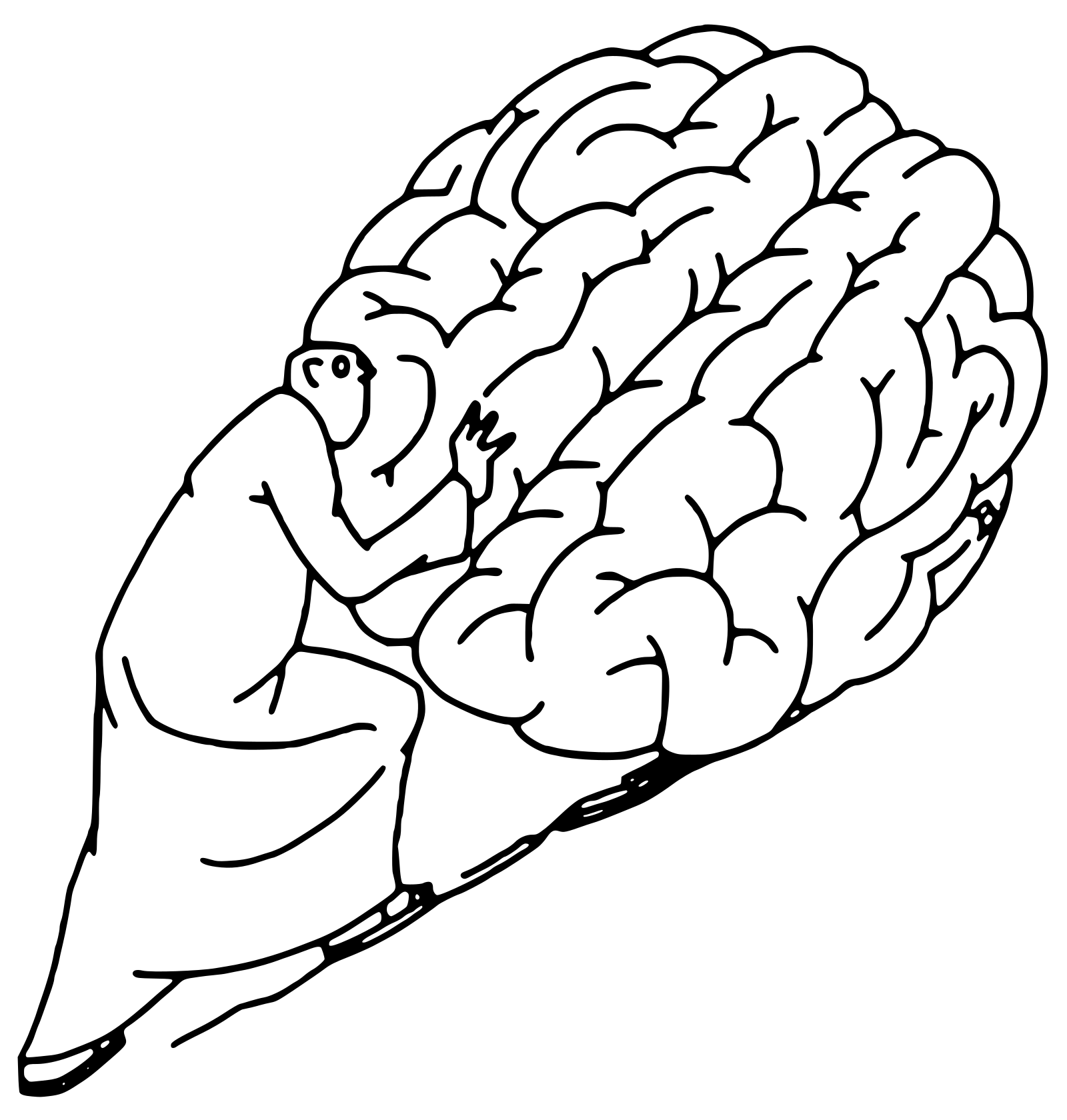
ALTERNATIVE MEDICINE IN THE CZECH REPUBLIC
AND SISYFOS
Jiøí Heøt
Department of Anatomy, Faculty of Medicine
Plzeò, Czech Republic
In the last decade, many different unconventional methods occurred among
our physicians and healers. This situation is held by many critics as a consequence of the
political changes after 1989, as an import from the West and as a new phenomenon. This is
only partially true as many methods of the Alternative medicine (AM) were in use
before 1989. Acupuncture, magnetotherapy and psychotronics were not only
tolerated, but supported by political authorities. Of course, the acupuncture was accepted
only in its new materialistic form, known as Traditional Chinese Medicine (TCM). Instead
of parapsychology, the name psychotronics was used and the effects were explained by
electromagnetism or by other, yet unknown, but material energy.
After 1989, nearly all other AM methods, from West and East,
massively invaded our country. Several different factors were the cause of such a boom. At
first, it was the novelty of queer, exotic methods, curiosity of the population,
publication of an immense quantity of journals an books on alternative medicine together
with magic, mysticism and other paranormal items. All new private media wanted to attract
the population by these interesting themes and a great role must be attributed to foreign
firms, producers of homeopathics, herbal products and diagnostic or therapeutic
instruments. The postmodern philosophy with its pluralistic principle and its animosity
against science had a great influence on Czech philosophers, politicians and some
scientists. Many physicians, frustrated by their bad economic situation, saw in the AM a
great occasion.
From the newly imported methods, the homeopathy, new variants of
acupuncture and the cluster medicine are the most important. Czech acupuncturists
“discovered” the opioid theory and the “sophisticated” Voll's electroacupuncture
as well as many microsystems described on the body surface by Nogier, Dale, Park and
others.
The great success of homeopathy was due to the activities of the French
firm Boiron and its aggressive Czech agents with massive propagation in all media, sharp
attacks onto the scientific medicine and with cheap weekend courses for physicians and
druggists. Nearly 5000 of them were instructed.
The anthroposophic medicine was not so successful. Only a small group,
rather inactive, of anthroposophic physicians exists in Hradec Králové.
Psychotronics under the new name biotronics is used in a greater extent
only by laic healers. Its materialistic theory was replaced by mystical, spiritual
concepts.
In contrast with the preceding methods, osteopathy and chiropractics are
nearly unknown, as the manipulation and mobilization were in our country accepted as
effective physical methods in the official medicine before long.
The opposition against the use of the ineffective AM methods is very
small. The Czech legislative and the Ethical Codex of the Czech Medical Chamber accept
only the evidence based medicine and no permission to open the praxis is given to lay
healers, but these laws are not respected.
All Czech state organs, the Ministry of Health, the Czech Medical Society
as well as the Czech Medical Chamber assume in praxis a rather tolerant position against
the AM. Their activities in discussing and solving this problem are insufficient. The
students in our seven Faculties of Medicine are not given information on the AM in general
or on individual “alternative” methods. The Czech Academy of Science issued no
official position or criticism of the AM.
Only small victories over the AM were achieved, mostly under the pressure
of our small club SISYFOS or its individual members. In the short period, when our former
chairman I.David took the post of the Czech Minister of Health, courses of homeopathy in
both Institutes for the postgraduate medical training were stopped. The Czech Medical
Association JEP excommunicated the Homeopathic Society in 1989 and cancelled the activity
of the section for the Voll´s electroacupuncture. The Czech Medical Chamber proclaimed
the cluster medicine as a non lege artis method, but homeopathy is accepted as a
complementary therapeutic method by this Chamber.
Only SISYFOS tries systematically to denounce the AM and to point out the
danger of the AM for the patients and for the medicine.
To enumerate our activities, we can speak on the presentation of our
critics in all media, we succeeded in publishing three monographs on the AM, we wrote and
sent many petitions and position-papers to all state institutions, with rather a small
effect.
We tried also to formulate an exact definition of the AM: 1. The AM is
based on a different paradigm (holistic, spiritual) than the scientific medicine. 2. The
theory and praxis of the AM methods are in conflict with physical laws and scientific
knowledge. 3. Direct, specific effects of he AM methods were not proven by scientific
methods. 4. Therapeutic effects of the AM can be explained by the placebo effect.
HOW IS PHILOSOPHO-THERAPY POSSIBLE?
Ahmet Inam
Department of Philosophy, Middle East Technical University
06531, Ankara, Turkey
E-mail: ainam@metu.edu.tr
Philosopho-therapy or philosophical therapy (it may also be called
“philotherapy” namely, love of therapy!) has a long history. Starting from the
classical period of Greek Philosophy through Hellenistic Age, philosophical activity can
be evaluated as ethically, epistemologically, and ontologically informed therapy.
Philosophy at that time was a way of life offering spiritual exercises:
meditation, dialogue with oneself, examination of conscience, exercises of imagination in
order to attain mastery of oneself. Nowadays philosophy has lost the spiritual character.
Philosopher began to tempt to take refuge in, to shut herself up in the discourse, in the
conceptual architecture that she has constructed without going beyond discourse in order
to take upon herself the risk of radical transformation of herself.
Although contemporary situation of philosophy is seemingly too “professional”, too “technical”; hopefully, the philosophical activity can still remember its past and can recover its original potentiality. It has its own realm of therapy, an open area of psychagogy (directing of soul).
The possibility of philosophy’s healing of wounds of human being confined in a windowless room of her “sick” soul by the troubles of everyday life may come from the fact that there is such a thing as noetic power at the hands of human being. Philosopho-therapy or philosophical therapy seeks out the various ways of enhancement of this noetic resource, the resource that can orchestrate the somatic, emotional, intellectual, environmental dimensions of human being.
In this paper, a conceptual expedition into the realm of philosophical therapy will be ventured.
BIG BOOM OF HEALING PRACTICES IN ONCOLOGY IN CZECH REPUBLIC DURING
THE LAST DECADE
Petr Lemež
Physician, M. D., Ph. D., Sisyfos
Prague, Czech Republic
E-mail: plemez@post.cz
The author uses the term healing practices as a synonym
for wrong terms of alternative, complementary, unconventional, etc. ...medicine and
defines it as: „all scientifically untested and/or without scientifically proved
efficacy practices of diagnosing diseases or treatment of persons carried out by healers
(persons without medical education) or even by medical doctors“. Healing practices are
in a sharp contrast with so called evidence-based medicine.
Historical overview of healing practices in the Czech Republic may disclose
some reasons for their boom during the last decade.
1) Before 1989 Czechoslovak medicine, as most sciences and social
activities, was under multilevel control of the Communist Party of Czechoslovakia (CPC).
Ministry of Health was the top institution in the centrally directed hierarchical
structure consisting of regional and district institutes of national health. Nearly all
medical doctors treating patients except those working in research institutes and medical
faculty teaching hospitals, were employees of these institutions. Committees for
Effective Pharmacotherapy were established in each of these institutions. One of
the main aims of these committees was to control and check medical prescriptions of
(expensive) medicines. These committees played sometimes a regulatory role against healing
practices. Various healing practices provided by medical doctors (selling of magnetic
water, homeopathy...) or by healers (herbal tea mixtures, psychotronics…) were tolerated
even in oncology, especially, if members of the Communist Party provided them. However,
these activities were removed to margins of society.
2) A loss of any control over medical and paramedical activities in the
Czech society and „a complete freedom euphoria after 1989“ opened up
free fields for many types of impostors including medicine.
3) The Communist Party claimed that it possessed the only
scientific theory of the development of human society, i.e. the marxism-leninism.
This attitude discredited science as a whole. This became evident after the retreat of the
omniscient marxism-leninism theory of the development of mankind.
4) Terms alternative, complementary, etc. …medicine
invented by impostors were successfully imported into Czech Republic and used to confuse
layman public. Unfortunately, these terms were accepted by medical doctors and even by
several members of Czech Sceptic Organisation Sisyfos.
Regaining freedom and abolition of control mechanisms in medicine after
1989 opened new fields for massive advertising campaigns led by financially strong
producers of products with unproven medical effects in the Czech Republic. Some
miracle-making stuffs, especially against cancer, got in the focus of the society’s
interest. Articles about such products are often published in popular medical and
paramedical (“Regenerace”) journals. Furthermore, there was a big boom of various
medical and paramedical journals and a large production of various advertising booklets
and leaflets. Healers got time for their presentation on TV and a TV series advertising
products with various enzymatic activities was presented with prominent Czech actors in
main roles.
Healers and quacks including various impostors used preferentially various
practices of faith healing or herbs extracts. Sometimes they recommended to stop
oncological therapy to their oncological clients which decision led to the impaired
clinical status of the patient.
Mistletoe extract (Iscador), other herbal extracts or enzymatic products of
the firm Mucos Pharma (Wobenzym, Phlogenzym) used by patients with malignant oncological
diseases are tolerated by doctors in medical departments including the most prominent
oncological centres in the Czech Republic. It is necessary to stress that the efficacy of
these products against these treated tumours (colon carcinoma, bone sarcomas, etc.) had
not been proved in prospective randomised double blind clinical trials. There are even
oncological medical doctors in the Czech Republic who recommend to use these products as
supportive agents to their patients or parents of sick children in these indications.
Because these products are relatively expensive the following strategy is sometimes
applied: The first package is sold to the patient at a lower price and the patient is
psychologically motivated not to discontinue to use the product and so he is forced to buy
more packages at the full market price. Unfortunately, the Czech Medical Chamber which
should serve as the legal guarantee for medical care quality distributes to their members
its journal with supplement “Medicina” that advertises e.g. products of the firm Mucos
Pharma.
What can be done against the use of these products without proved efficacy
in patients with cancer?
1. To inform the public, patients and institutions about the unproved
efficiency of healing practices for treating malignant tumours.
2. Immediately stop using the terms such as „alternative, complementary,
holistic etc. ..medicine“ which means the intentional nonsense to confuse the layman
public. We should promote the terms „healing practices“, „quackery“ or some others
without the word medicine to describe all these practices characterised by unproved
efficiency for the patients.
This approach can clearly delineate the border between today‘s modern
(evidence – based) medicine and other attitudes to the patients.
FACTORS INFLUENCING FREQUENCY OF ALTERNATIVE
MEDICINE
Choudomir Nachev
Head of Internal Clinic at "St. Anne" University Hospital, Sofia
President of the Bulgarian National Academy of Medicine
1, Acad. Evgeni Pavlovskii Blvd., Sofia, PO Box 1784, Bulgaria
E-mail: nachevh@tradel.net
The alternative medicine is an objective phenomenon for all countries.
The number of specialists, opened consulting rooms and the part of the patients, who are
subjected to the methods of alternative medicine - all these - are quite variable
quantities among different countries as well as in a certain country at different stages
of its economic state and political situation.
The post-socialist countries can be cited as an illustration for the
unusual role of the chronic stress upon their population as a factor strongly aggravating
the relative part of alternative methods of diagnosis and treatment.
The following factors take part in flourishing of alternative medicine, at
least in the European countries:
0. Not all of the diseases can be treated by medical
methods despite the outstanding progress of medical science and practice.
0. Organization negligence in diagnostic and healing
processes causes distrust in many patients and motivates them to look for an alternative.
0. Attention of the medical staff to the patients is
not always careful enough. Roughness, made by a doctor, very often leads patients to
alternative medicine consulting rooms.
0. Specialists in the field of alternative medicine
are exceptionally skilful in making promises for therapeutical success within terms and
degree very often quite different from the possibilities of classical medicine.
0. The developed sense of healers to perfection
together with the methods of alternative medicine for entire effect on the patient,
attention and concern to his fate, approaches often impossible for doctors in classical
medicine because of their professional duties.
0. Anecdotic results of a given alternative approach,
spreading all over as amazing success from mouth to mouth, create faith in the omnipotence
of the healer.
0. Subconscious belief of the patients in the
existence of wonders, which could be done just for them.
With the abolishment of the so called socialist healthcare, these countries
started creating a new type of health system - institution of general practitioners,
formation of diagnostic and consulting centres, changing hospitals into trade companies.
All that resulted to unusual dislocation of specialists in healthcare system. Economic
interest led doctors to places, where their competence was inadequate to the assigned
duties. This fact strongly discredited (though temporarily) healthcare prestige in the
country. There was made real vacuum of authoritative healers.
Simultaneously with the crisis in healthcare at this period, at least in
Bulgaria, the economic difficulties of the population as a whole were tangibly increased.
Inaccessibility of drugs, which they could buy, for a large part of people
resulted to inadequate treatment of most of the patients.
Naturally, people directed their eyes to alternative ways. This situation
was best for those, who had some gift, competence or possibilities to open alternative
medicine consulting rooms.
The consequence is flourishing of alternative medicine.
Until what time will it go on? It is difficult to predict, but surely it
will not be for long. In the nearest future medical systems in post-socialist countries
will be put on a sound footing of modern medical organization, like the one in the rest of
the European countries.
THEORY AND PRACTICE OF QUACKBUSTING: THE DUTCH EXPERIENCE
Cees N.M.Renckens
Gynaecologist
Chairman Dutch Union against Quackery
Ramen 32, 1621 EL Hoorn, The Netherlands
E-mail: renckens@xs4all.nl
In the last quarter of the twentieth century the Netherlands has seen an
impressive rise in the popularity of quackery, disguised as alternative medicine or - as
the proponents of this practices nowadays prefer to call it - 'additive medicine',
'complementary medicine', 'holistic medicine' or even worse: 'integrated medicine'. This
phenomenon was rightly called paradoxical by James Le Fanu in his commendable The Rise and
Fall of Modern Medicine (Abacus, 1999), which described the strong progress made by the
regular medicine in the period immediately preceding this rising popularity of alternative
medicine.
Before 1975 the non-orthodox healers in the Netherlands were almost for
100% non-doctors, practising naturopathy (herbs), faith healing and magnetic healing
(later renamed as paranormal therapy). The law forbade medical practice for those without
a (university-acquired) medical diploma and the quacks of those days were always at risk
of legal problems. However this law on the practice of medicine that dated from 1865 was
precisely the law that - more than any other law - from the beginning was infringed at an
enormous scale. And when quacks were brought to court, the penalties were usually so mild,
that they resumed their practices immediately after the verdict.
In the fifties and sixties the government was studying a change in the law
and awaiting this change of the legal context the judges stopped punishing quacks, unless
there was serious risk to the health or clear-cut swindling. This change of the law
entailed that medicine is a free profession that can, with exception of a number of
'reserved acts', be practised by anyone. The parliament accepted the new law in 1996
unanimously. The times, they had indeed been changing, as there was no objection from the
Dutch Medical Association that in 1849 was more or less established to fight quackery.
Because of the numerous infringements of the law and the weak response from the legal
authorities in 1881 the Dutch Union against Quackery was founded. Members were mainly
doctors and pharmacists, but anyone worried about health fraud and quackery can be a
member. At this moment the membership is around 1250.
The start of alternative medicine in the Netherlands can be dated around
1975, when Prince Bernhard, the husband of the queen, visited an acupuncturist. The Dutch
royal family has a long tradition of contacts with quacks like faith healers, paranormal
healers and people with divining rods. At regular intervals homeopathic doctors and
acupuncturists are awarded royal decorations!
The Dutch Union against Quackery had a difficult period around 1975 because
their main objects of criticism, the non-doctors, were no longer outlaws and their
practices were being accepted by nearly everyone in the Dutch society. After realising
that the 'alternative medicine' was just as serious a problem, or even a more serious one,
than the traditional quackery, the Union rewrote theirs statutes and decided to
concentrate on the alternative medicine, even although increasing numbers of doctors
started to practice this branch of professional 'assistance'. In spite of our efforts
there has been an increase in the number of alternative practitioners, doctors and
non-doctors, since then, but since about five years there seems to be a steady state or
even a decline. Some statistics in this respect will be shown during the lecture. The
number of alternative doctors is at present about 1100, but not all of them do practice.
The figure of 1100 means that they form between 2 and 3% of all doctors in the country.
The Union against Quackery has been active in trying to influence public,
professional as well as political opinion. Supposedly natural allies were not always on
our side and sometimes we feel 'surrounded by dangerous madmen', as the famous Dutch
novelist and polemic writer W.F.Hermans once said about himself. One of his books was
titled 'I am always right'. It is a good thing that set-backs can make someone stronger,
as we were quite unhappy with parliamentary opinion, with the very soft attitude of the
Dutch Medical Association (KNMG) that tolerates alternative doctors in its midst, with the
Consumers League, that is already happy when people are not robbed, with the Dutch Cancer
Society, a charity-fund that co-operates with alternative 'cancer-specialists' and finally
with the Dutch legal authorities that still - loyal to their tradition - seem to favour
alternative doctors above those who severely criticise doctors, which are unloyal to their
professional values. Some examples of this kind of experiences will be presented in the
lecture.
Until recently alternative doctors were writing their fairy tales in
second-rate journals and the international scientific community, represented in scientific
associations and peer-reviewed medical journals, benignly neglected the reports on the
blessings of sub-Avogadro diluted homeopathic drugs, of Chinese 'pre-Vesalian' anatomic
mythology and of the naturopathic preoccupation with 'polluted bodies' and 'crippled
colons' and so on. In daily practice the world of regular medicine (a tautology, of
course!) and alternative medicine were divided by a broad and unbridgeable gap and that
was not so bad. Scientific research into alternative medicine has been subsidised by the
Dutch government in the eighties and no usable alternative treatments were found. Serious
investigators did not risk their reputation by examining 'absurd claims' and they were
right. Petr Skrabanek stressed the problems of randomised trials of absurd claims and, in
a very eloquent manner, argued for 'rational scepticism': the dogmatic unbelief in the
absurd. Too much 'neutrality' is not the way to 'demarcate the absurd'. (Read 'Demarcation
of the absurd', Lancet 960-1, 26 April 1986 and, Czech friends, erect a statue
for this exemplarious writer and thinker!) In the Netherlands government-subsidised
projects were started in which regular doctors were to co-operate more closely with
alternative practitioners. The results were not spectacular, did not lead to permanently
better relations and some of the results from this trial will be presented.
A rather new and highly disquieting phenomenon has been that prestigious
bodies in the regular medicine, The Lancet, BMJ and BMA, are nowadays accepting
more and more papers on alternative treatments. They are only able - so I sometimes do
think secretly - to do so because Petr Skrabanek, who died much too early in 1994 is not
anymore around to castigate the editors for their policy. It seems, that the Britons have
gone mad and are now propagating 'integrated medicine', strongly encouraged by their
leader, the Prince of Wales. Chinese medicine is presented as - in many respects -
superior to the Western medicine and orthodox medicine can allegedly learn a lot from
homeopaths and alike (BMJ, 20 January 2001). This policy reminds us of the words
of British Prime Minister Neville Chamberlain, who after the Munich Agreement of 1938 with
Hitler said: 'I believe it is peace for our time…peace with honour'. The results of
concessions to a system, that seems to be in a winning position but that actually is of an
unwanted nature, are well-known to the people of Czechoslovakia and all of us and I
predict that accepting or even praising of the caprices, absurdities and frauds of
alternative medicine represents a identical short-sighted misjudgement. In the USA a
similar trend can be expected as the NIH in Bethesda accommodates a heavily subsidised
centre for alternative medicine, producing all kind of papers that, to the superficial and
uncritical observer (a kind of people sometimes even seen in editorial boards of medical
journals), seem to be engaged in separating 'the chaff from the wheat'. The good observer
never saw any wheat, to say the least.
Medicine should trust on its own strength and is has only been able to
achieve the present level of its practice by sticking to rational, critical and
competitive science, which after being accepted by an uncompromising scientific community,
must be tailored to the individual needs of the individual patient. It is this opinion on
which the Dutch Union against Quackery founds its endeavours to maintain and promote a
strong internal discipline in the medical profession and by doing so tries to protect the
patient. I am 100% sure of the fact that Petr Skrabanek, who called himself amongst not
only 'connoisseur of the absurd' but also 'doctor of medicine' would have agreed with this
opinion.